

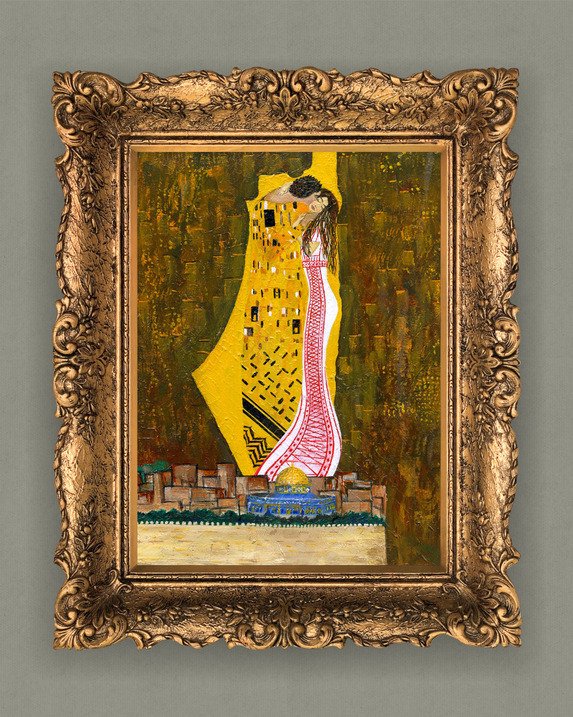
Euphoria began as an experiment—what would happen if one of the most famous embraces in Western art was reimagined through a Palestinian lens? The answer turned out to be far more powerful than I ever anticipated.
Gustav Klimt’s The Kiss has always been about intimacy, about two people wrapped in a world of their own. But I wanted to ask: what does that embrace look like when it carries the weight of displacement? When the gold leaf becomes the shimmer of the Dome of the Rock, and the decorative patterns become the geometric precision of Palestinian Tatreez embroidery?
The lovers in Euphoria are not simply embracing each other. They are holding onto memory itself—the scent of olive groves, the sound of the call to prayer echoing through narrow streets, the warmth of a grandmother’s kitchen. Their embrace is an act of cultural preservation.
What surprised me most was the response. When Euphoria went viral, messages poured in from Palestinians around the world—from Chile to Australia, from Sweden to the Gulf. Each person saw their own story in that embrace. A mother in Ramallah told me it made her weep. A university student in Toronto said it was the first time she felt her identity celebrated rather than questioned.
The Keffiyeh patterns woven into the composition are not decorative choices—they are declarations. The traditional Palestinian dress motifs are not ornamental—they are ancestral voices speaking through colour and form.
Euphoria taught me that art does not need to shout to be heard. Sometimes the quietest gestures—an embrace, a pattern, a golden hue—carry the loudest truths.